Species Information
Kingdom: Plantae
Phylum: Anthophyta
Class: Dicotyledoneae
Order: Solanales
Family: Hydrophyllaceae
Genus: Phacelia
Species: serrata
Cinder Phacelia - Phacelia serrata
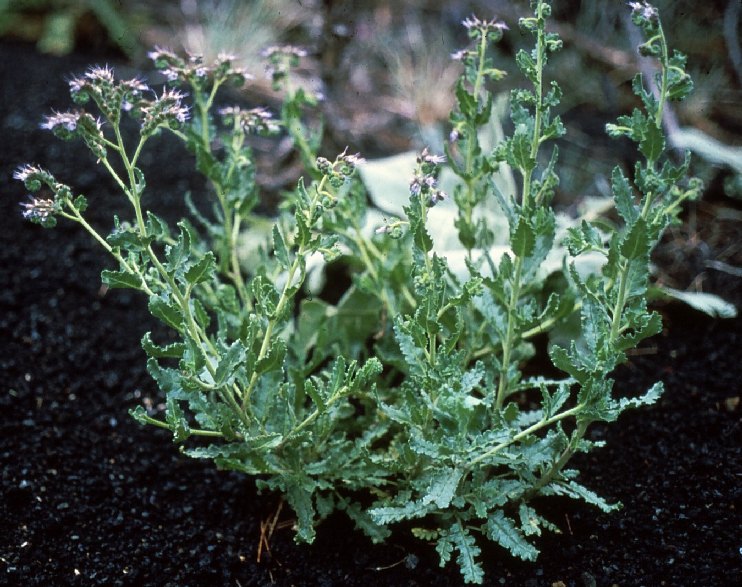
Image courtesy of New Mexico Rare Plants
597630
Species Extent (New Mexico)
General Description
Annual; herbage strongly glandular and sticky; stems 1-3.4 dm tall, erect, simple or branched at base, with simple setose, hirsute and multicellular glandular hairs; leaves lanceolate, serrate, dentate to shallowly lobed, 1-4 cm long, 0.5-2 cm wide, with basal leaf cluster especially apparent when young, leaves gradually reduced upward, the upper sessile or nearly so, the lower with petioles to 1.5 cm long; inflorescence of compound scorpioid cymes, setose, puberulent with multicellular stipitate glands; pedicels to 1 mm long; sepals elliptical to oblanceolate, more or less keeled at base, 3.5-6.5 mm long, 1.5-2 mm wide, setose, puberulent and stipitate-glandular; corolla of 5 united petals, rotate (appearing tubular in some pressed specimens), blue to light violet, 3-4 mm long and broad, pubescent; stamens and style exserted, style bifid 3/4 its length, lower 1/4 pubescent; capsule subglobose, 2.8-3.5 mm long, 2-2.5 mm wide, glandular and puberulent; mature seeds 4, elliptical to oblong (sometimes unequally so when one of the margins is involute), dark brown, 3-3.2 mm long, 1-1.3 mm wide, excavated and divided by prominent ridge, the ridge corrugated on one side, the margins corrugated, pitted and often one or both involute, dorsal surface smooth and shiny to somewhat dull, sometimes faintly pitted, the tip and margins darker for part of their length (or at least different in appearance from the rest of the dorsal surface). Flowers July to October, primarily late August and early September.
Status
Observations in Natural Heritage New Mexico Database
Number of Subpopulations: 9
Number of Mapped Locations: 14
Number of Observations: 16
Observation date range: 01-01-1991 to 07-20-1998
External Links
View More Information about this species at:
NatureServe Explorer
New Mexico Rare Plants Website
Environmental Conservation Online System (ECOS)
NatureServe Explorer
New Mexico Rare Plants Website
Environmental Conservation Online System (ECOS)