Species Information
Kingdom: Plantae
Phylum: Anthophyta
Class: Dicotyledoneae
Order: Capparales
Family: Brassicaceae
Genus: Physaria
Species: pruinosa
Pagosa Bladderpod - Physaria pruinosa
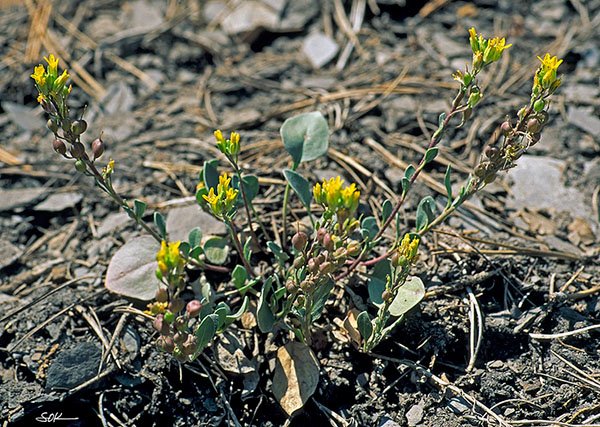
Image courtesy of New Mexico Rare Plants
800539
Species Extent (New Mexico)
General Description
Perennial, more or less densely pubescent with closely appressed more or less stellate trichomes, these 0.2-0.3 mm in diameter, sessile or substipitate, smooth or finely granular, rays 4-7, distinct but stout and usually contiguous at their bases and thus scale-like, forked or bifurcate; stems to 2 dm long, decumbent or erect, arising from a simple or divided woody caudex; basal leaves 4-8 cm long, 11-17 mm wide, blades suborbicular or obovate to rhombic, entire to sinuate or shallowly toothed, narrowing abruptly to the long petiole, abaxial surface with dense and overlapping trichomes, adaxial surface with trichomes often barely contiguous; stem leaves 0.8-2.3 cm long, 2-11 mm wide, obovate to rhombic, entire to shallowly toothed, the lower ones petiolate, those above sessile, pubescence as on the basal leaves; inflorescences dense; buds large and ellipsoid; sepals about 6 mm long, the lateral ones elliptic, cucullate, not saccate or barely so, median sepals oblong, cucullate, thickened at the apex; petals about 9 mm long, yellow, spathulate and expanded at the base; filaments slightly expanded in their proximal half, paired stamens about 7 mm long, single stamens about 6 mm long; glandular tissue + completely surrounding each single stamen (thickened on the lower side) and subtending the paired stamens but not developed between the latter; infructescences elongated and dense; pedicels 8-11 mm long, stout and expanded at the summit, sigmoid and + horizontal to the axis or slightly curved and spreading; silicles 6-9 mm long, sessile or substipitate, globose or ellipsoid (then sometimes slightly obcompressed), valves inflated and rather thin, peaked at the apex, glabrous within and without; septum entire, very little wrinkled, funicles attached 1/3 or less their lengths; styles 3.5-7.0 mm long, slender, stigmas slightly expanded; ovules 2-4(6) per locule; seeds 2.5-3.0 mm long, suborbicular to oblong (a little broader than long), somewhat flattened, orange-brown, neither margined nor winged; cotyledons accumbent, about twice as long as the radicle (Rollins and Shaw 1973). Flowers May to August.
Status
Observations in Natural Heritage New Mexico Database
Number of Subpopulations: 3
Number of Mapped Locations: 3
Number of Observations: 3
Observation date range: 06-06-2000 to 05-21-2323
External Links
View More Information about this species at:
NatureServe Explorer
New Mexico Rare Plants Website
Environmental Conservation Online System (ECOS)
NatureServe Explorer
New Mexico Rare Plants Website
Environmental Conservation Online System (ECOS)