Species Information
Kingdom: Plantae
Phylum: Anthophyta
Class: Dicotyledoneae
Order: Solanales
Family: Polemoniaceae
Genus: Phlox
Species: vermejoensis
Vermejo Phlox - Phlox vermejoensis
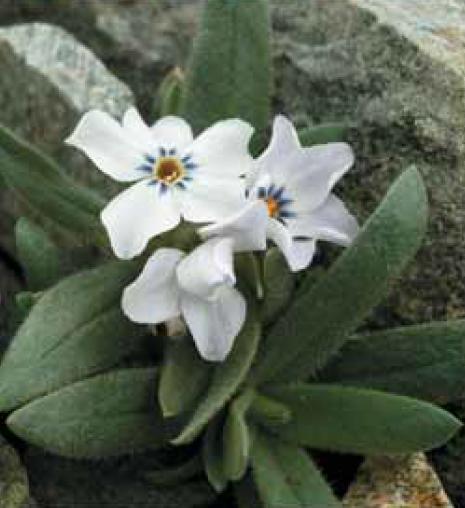
Image courtesy of New Mexico Rare Plants
884245
Species Extent (New Mexico)
General Description
Perennial herb with numerous branched and tangled rhizomes from a central caudex; above-ground stems solitary or in clumps, arising from upturned rhizome tips, forming short, leafy tufts 1-4 cm tall; leaves opposite and sessile, spreading to ascending, blades elliptic, oblong, or oblanceolate, 6-25 mm long, 3-8 mm wide, the tips acute to obtuse, occasionally apiculate, surfaces and margins glabrous to moderately pubescent with gland-tipped hairs; inflorescence a terminal, reduced, leafy cyme with 1-4(-6) flowers; pedicels 1-4 mm long, densely pubescent with gland-tipped hairs; sepals 5, narrowly lanceolate to almost linear, 8-11 mm long, 0.4-0.7 mm wide, united for 4-5 mm at base, outer surface densely pubescent like the pedicels; corolla salverform, regular, white or rarely tinged with pink, often with purple "pinwheel" markings at throat, tube (7-)8-11 mm long, equaling the calyx, lobes 5, spreading, obovate, 6-9 mm long, 4.5-7.5 mm wide, entire; filaments unequally attached on upper half of corolla tube; anthers included or some slightly exserted, positioned above the style and stigmas; ovary superior, glabrous, with 3 carpels and 3 locules, each containing a single ovule; capsule 4.5-6.5 mm long, 2-3 mm wide, elliptic, tan, glabrous, hardened, with 3 valves; seeds light brown 3-3.6 mm long, 1-1.8 mm wide. Flowers in July.
Status
Observations in Natural Heritage New Mexico Database
Number of Subpopulations: 2
Number of Mapped Locations: 6
Number of Observations: 6
Observation date range: 07-18-2009 to 07-21-2015
External Links
View More Information about this species at:
NatureServe Explorer
New Mexico Rare Plants Website
Environmental Conservation Online System (ECOS)
NatureServe Explorer
New Mexico Rare Plants Website
Environmental Conservation Online System (ECOS)